

Web Development Guide for Beginners: Planning, Building, and Launching
Explore the web development process, from planning to maintenance, in this beginner-friendly guide.
Read articleWeb development
A realistic web development timeline helps you plan, avoid delays and set realistic expectations. Learn what shapes website development time and how to manage it.
You learn how a web development timeline is shaped by project type, complexity, content readiness and feedback cycles. The article explains each project phase, common risks and practical steps to set a realistic schedule. It also shows how to assess a developer's timeline proposal and what to prepare for a smoother delivery.
The kind of website you need, from a landing page to a custom application, is the main factor in how long development takes.
Delays in preparing or approving content are a leading cause of project overruns.
Defining tasks, assigning roles and setting milestones keeps the project on track.
Slow stakeholder feedback or repeated revisions can extend the project timeline.
A realistic web development timeline tells you more than when your website might go live: it shows what needs to happen before launch and whose decisions could hold it up. A simple page may need little development work, but content, feedback, integrations and testing can still change its delivery date.
For a new business website, redesign or custom web application, the useful question is not simply how many days developers need to write code. This guide explains likely schedules, the stages behind them, common causes of delay and how to evaluate a proposed launch plan before committing your budget.
Website development can take anywhere from a few hours to several months, depending on what you are building and how much is already prepared. A standard content website is generally less involved than an online store or custom application with user accounts, transaction processing and integrations.
| Project type | Illustrative planning range | Main work affecting the schedule |
|---|---|---|
| Simple landing page | Hours to a few days | Content, layout, forms and basic checks |
| Small business website | Several weeks | Multiple pages, design approvals, content and CMS setup |
| E-commerce website | Several weeks to several months | Product catalogue, checkout, payments and order flows |
| Custom web application | Several months or longer | Bespoke features, data, integrations and extensive testing |
These timelines are illustrative estimates rather than fixed industry averages or guaranteed delivery dates. The actual time required depends on your website's complexity, number of pages, functionality, content readiness and approval process, so requesting a project-specific estimate is the best way to establish a realistic schedule.
A website project timeline covers discovery, planning, design, development, content preparation, testing and deployment. Some stages overlap, but each produces work that must be reviewed before the project can move ahead confidently.
Your team does not need to wait until every development stage is complete before preparing for the next, as activities such as content creation and design can often progress simultaneously. Following a clear website development lifecycle helps businesses coordinate tasks, reduce project delays and use resources more efficiently, supporting a smoother launch and better control over development costs.
Development duration is driven by scope, complexity, technical dependencies and the speed of decisions, not just the number of developers available. Some factors can be controlled before work begins, while others become clearer as designs and systems are reviewed.
When comparing estimates, ask which of these factors has already been assessed and which remains an assumption. A short estimate with unexamined integrations or content dependencies may be less useful than a longer schedule with clearer responsibilities.
A new website, redesign and series of targeted improvements can require very different schedules, even for the same business. Existing content and code may save work, but they can also create migration or compatibility challenges that a new build would not face.
| Approach | What can be reused | Key schedule risks | When it can fit |
|---|---|---|---|
| New build | Brand assets, content and established components | New architecture, requirements and design decisions | A business needs a new platform or substantial functionality |
| Redesign | Existing pages, data, integrations or content structure | Content migration, redirects, legacy code and stakeholder feedback | The site needs a major usability or presentation update |
| Incremental improvement | Most current pages and infrastructure | Regression issues, release coordination and hidden dependencies | Specific features or problems can be tackled separately |
A redesign is not necessarily faster than building a new website, as reviewing existing features, migrating content and resolving compatibility issues can extend the project timeline. Carefully evaluating the design and redevelopment requirements helps businesses choose the most suitable approach, allocate resources effectively and avoid costly delays while keeping the project aligned with their budget and launch goals.
A practical schedule lists tasks, dependencies, owners and review dates rather than showing one uninterrupted block labelled “development”. It should make visible which activities can happen together and which are waiting on earlier work.
For example, a team can approve project requirements while content creation is underway, then review designs before the relevant pages move into development and testing. By coordinating these activities and setting clear approval deadlines, businesses can reduce unnecessary delays, improve collaboration and maintain steady progress throughout the project.
Most timeline problems become harder to solve when nobody has clearly assigned responsibility for them. Missing material, conflicting feedback and undiscovered integrations can hold up later work even while developers are available.
When a delay appears, identify the affected task, what is blocking it and whether unaffected activities can continue. A revised schedule should show the impact plainly instead of quietly moving the launch date without an explanation.
Faster delivery comes from removing avoidable waiting and concentrating effort on what the first release needs. Speed should not mean treating security, accessibility or functional checks as optional afterthoughts.
A phased launch can be effective when an initial version meets users' core needs and later enhancements have their own plan. Protecting time for implementation and refinement is often a better business decision than committing to an attractive date that the project cannot support.
A useful estimate explains what will be delivered, what the schedule assumes and how changing requirements will be handled. It should also show which responsibilities belong to the business, because those responsibilities can affect the completion date as much as technical work.
Use the proposal to compare how clearly each development partner defines the project scope, responsibilities and delivery schedule, rather than focusing only on speed. For websites requiring additional functionality or integrations, consider how the complexity of a tailored development solution affects the overall workload, development costs and estimated completion date.
Dev Centre House helps businesses plan website projects with clearer timelines, realistic budgets and measurable business goals. Through tailored web solutions, the team helps define project scope, prioritise essential features and identify factors that influence delivery time, including content readiness, technical requirements and integrations.
Whether you are building a new website or improving an existing one, understanding the work involved can help you avoid unnecessary costs, reduce delays and make more informed investment decisions. Book a consultation with Dev Centre House to discuss your requirements, assess project complexity and explore a realistic development timeline aligned with your business priorities.
A realistic web development timeline should be based on measurable project requirements, including the number of pages, feature complexity, content readiness, integration needs and available resources. Tracking milestones, approval times and changes in project scope helps businesses identify potential delays, manage development costs and make better decisions throughout the project.
Before committing to a launch date, evaluate your project priorities, expected deliverables and the resources required to achieve your business goals. Considering how website design and functionality requirements, along with business integrations, affect development time can help you set realistic expectations and avoid unnecessary delays. Book a consultation with Dev Centre House to discuss realistic timelines, budget considerations and the most practical approach to development.
Frequently Asked Questions
Short answers on the points readers most often want clarified after this piece.
It depends on scope and complexity, with simple sites potentially taking days and custom applications often requiring a substantially longer schedule.
Having approved copy, images and product information ready can prevent pages and approvals from waiting on missing materials.
A narrowly scoped site with prepared content and quick approvals may be possible in a week, but that is not a reliable promise for every project.
Your team should assess the additional design, development and testing work, then agree on any changes to the schedule and budget.
Look for a documented scope, milestones, dependencies, client responsibilities, testing allowance and a clear process for handling changes.
Keep reading
Explore the web development process, from planning to maintenance, in this beginner-friendly guide.
Read article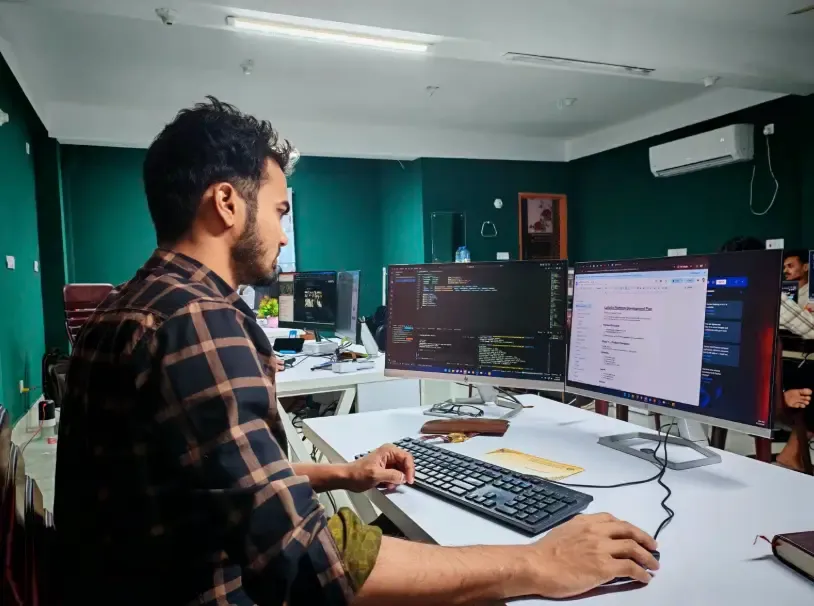
How web development works, step by step, so you can make informed decisions, avoid costly mistakes and guide your website project from planning to launch.
Read article
Full stack web development means building both frontend and backend systems so your application works as one. Learn which skills, technologies and roles you need.
Read articleStart a conversation
Have a new product in mind, an existing system that needs improvement, or a complex business challenge to solve? Tell us what you're looking to achieve, and our team will help you find the right way forward.
We'll understand the problem before recommending a solution.
Get clarity on possible approaches, technologies, and next steps.
Work with experienced professionals across strategy, design, development, and technology.
A straightforward conversation about your project and requirements.
You don't need a complete specification to start a conversation.
Whether you have a detailed project brief or just an early-stage idea, we'll help you understand what's possible and what to do next.
No pressure. No unnecessary jargon. Just a conversation about what you want to build.
Tell us about the work
Your information is kept confidential and will only be used to respond to your enquiry. Privacy Policy
Prefer to Talk First?
That's okay. Start with a conversation.

Suite 5, Plaza 256, Blanchardstown Corporate Park 2, Dublin 15, D15 VE24, Ireland
+353 1 531 4791
Floor 3 East - 3E - 501 5th St - Dubai Int'l Airport, Dubai Airport Free Zone (DAFZA), Dubai, United Arab Emirates
+353 1 531 4791


